

A year and a half after the federal government’s withdrawal of funding that once moved food from local farms to local families, the damage is starting to show. USDA’s own data caught the first signs of it, before the agency shut down the survey that produced the data, leaving food banks and outside researchers to track what the government now declines to measure. It has also shown up in the growth — and, most recently, the recognition — of a local organisation that built a private alternative before the federal one collapsed.
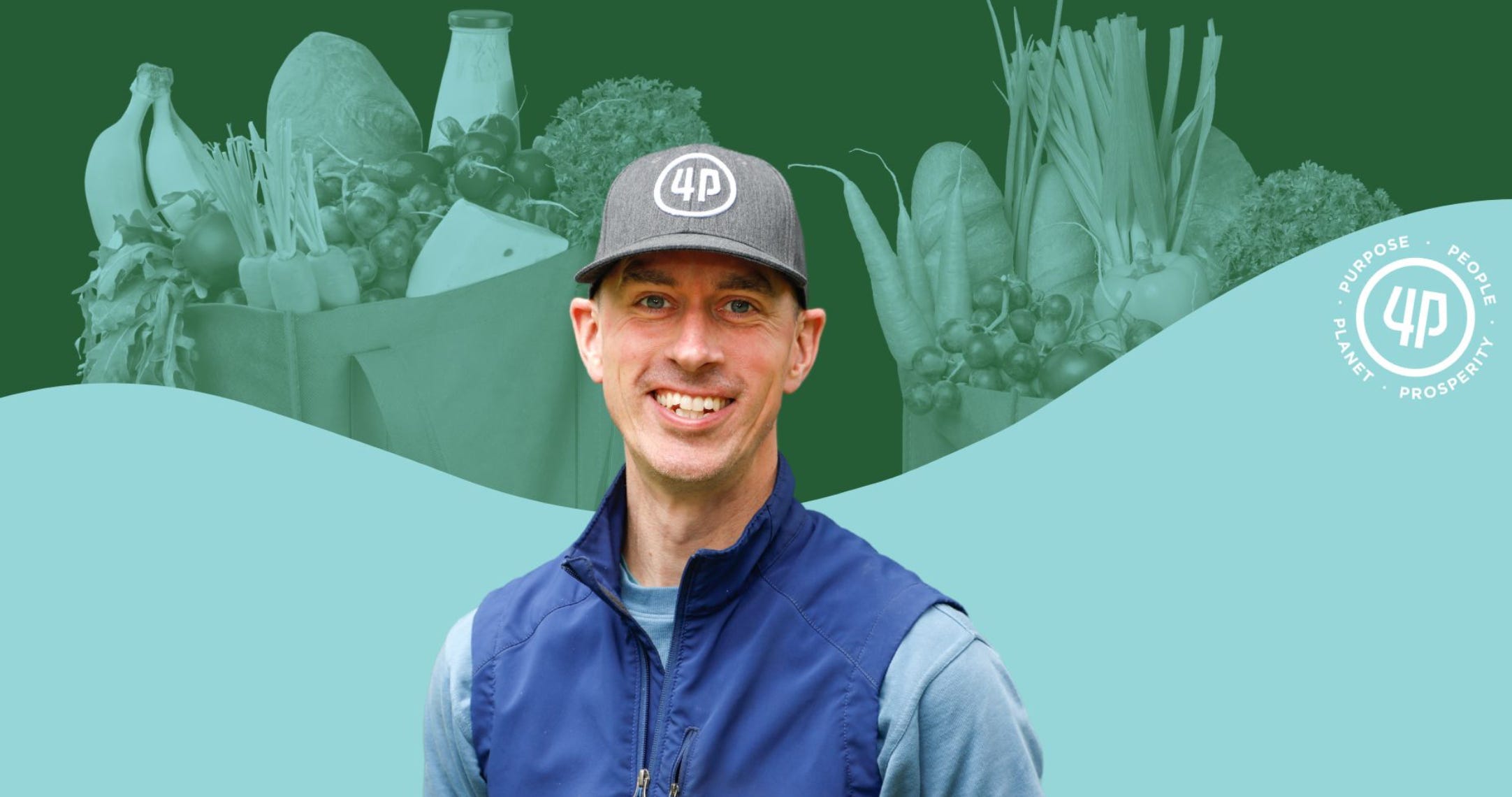
Tom McDougall founded 4P Foods (4P being Purpose, People, Planet, Prosperity) in 2014 as a Kickstarter, raising just over five thousand dollars from forty-nine backers. He has spent the decade since building what he calls a hub-and-spoke model — a coordinating platform for more than two hundred farmers and producers across the Mid-Atlantic, who are feeding schools, hospitals and a growing list of Food-is-Medicine partnerships — collapsing what is usually ten transactions between field and plate down to two: farmer to 4P, 4P to customer. When the Local Food Purchase Assistance (LFPA) and Local Food for Schools (LFS) programmes — both built during the pandemic to route locally grown food into cafeterias and food banks — were eliminated in March 2025, McDougall was incredulous. LFPA, he told me, was never really the Biden-era programme Trump accused it of being, but a rebrand of the Farmers to Families Food Box initiative, something Trump's first administration had built. "Why not double down," McDougall said at the time, "especially as we're imposing tariffs on imported produce?"
But let me back up for a minute. A financial reporter by background, I started out covering the agriculture beat at Business Day — at the time, South Africa’s equivalent of the Wall Street Journal. I now live in Fauquier County, Virginia, about an hour west of Washington DC and not far from where McDougall built 4P Foods. My vantage point matters because Virginia is an agricultural state, with more of its land occupied by farms and pasture than the data centres and defence contractors that dominate its headlines.
Last April, when reporting on the early wave of the Trump administration’s cuts, I spoke with Eugene Triplett, a fifth-generation farmer in Culpeper County who had scaled up his vegetable operation on the strength of those programmes and lost the guaranteed market overnight. “It’s kind of like if you’re working and you thought your paycheque was $1,000 per week and now it’s only $25,” he told me. I also spoke with Carla Cash, executive director of the Mid Atlantic Food Resilience and Access Coalition, whose organisation had used LFPA funding — routed through a grant from 4P Foods — to run nutrition classes and get healthy food boxes to people managing diabetes, as well as pregnant women and the homeless. She called the cuts “a devastating blow,” one that left her coalition with a $2 million shortfall.
Triplett’s experience is not an anomaly. Chapter 12 farm bankruptcy filings rose 46 percent nationally in 2025 — the third consecutive year of increases, following a 55 percent rise the year before. The Midwest and Southeast accounted for most of it, each up roughly 70 percent. This year, USDA projects total farm debt will reach a record $624.7 billion, even as net farm income is forecast to fall to $153.4 billion.
Since my original story, the national picture has got worse in ways that are increasingly hard to measure. In 2024, the USDA’s Economic Research Service found that 47.9 million Americans — 13.7 percent of households — were food-insecure. That report, released in December 2025, was the agency’s last. The Trump administration has since confirmed that it was discontinuing the annual food security survey altogether.
The Federal Reserve Bank of New York, which has been tracking a related measure, found the share of households with limited or uncertain access to adequate food rose to 10 percent this year, up from 4 percent in June 2020. Among households receiving SNAP benefits, that same survey put food insecurity at 46 percent as of last November, up from 36 percent in recent years. The One Big Beautiful Bill Act, the reconciliation law Congress passed in July 2025, is projected to cut a further $187 billion from SNAP over the coming decade.
LFPA and LFS were not the only programmes cut. In March 2025, USDA pulled $500 million in Commodity Credit Corporation funding from the Emergency Food Assistance Program, or TEFAP, which supplies more than a fifth of everything the Feeding America network distributes nationally. USDA data obtained by ProPublica shows the resulting cancellations, between May and September last year, cost food banks nationwide roughly 94 million pounds of already-promised food. Feeding America West Michigan alone was left scrambling to replace 32 truckloads of it.
The strain has only continued to deepen. The Center on Budget and Policy Priorities estimates that SNAP participation fell by more than 4.5 million people between the reconciliation law’s enactment in mid-2025 and April 2026, including more than 1.5 million children; separate USDA data put the decline at nearly 5 million between January 2025 and February 2026. Feeding America’s network has been scrambling to absorb the difference with member food banks reporting demand increases of 25 to 40 percent. In San Antonio, a food bank that typically serves 105,000 to 120,000 people a week was, at one point last November, serving close to 170,000.
WIC — the Special Supplemental Nutrition Program for Women, Infants, and Children, which provides food benefits, nutrition counselling and health referrals to nearly 7 million low-income pregnant women, new mothers, infants and young children — has, for now at least, avoided the same fate. Congress rejected the administration’s proposed cut to its fruit-and-vegetable benefits in the FY2026 appropriations law, and the deal that ended last October’s government shutdown protected WIC’s funding through October 2026. That said, WIC eligibility is often automatic for families already enrolled in SNAP — the precise benefit the National WIC Association estimates hundreds of thousands of infants and young children are at risk of losing purely as a side effect of the SNAP cuts.
Back in my home state, the Federation of Virginia Food Banks estimates more than one million people are food insecure for the first time in the state’s history, with eight in ten of the localities with the highest food insecurity rates in rural areas. The state’s SNAP enrolment has dropped by more than 100,000 people in the past year, from roughly 825,000 to just over 700,000, of whom 325,000 are children — families with children make up 67 percent of the state’s SNAP caseload. Between May and August of last year, more than 1.7 million pounds of food aid earmarked for Virginia’s seven main food banks was cancelled, including some 550,000 pounds of chicken, enough to leave roughly 6,400 typical households without that staple protein for four months. The Blue Ridge Area Food Bank, which serves 25 counties and eight cities across western and central Virginia, saw demand rise 16 percent over the past year — it now sits 45 percent above its pandemic peak and last October was its second-busiest month in 44 years of operation.
In December 2025, the administration announced a $12 billion bailout for farmers — including up to $11 billion in “bridge payments,” plus $1 billion for specialty crops — meant to offset losses from Trump’s tariffs. An analysis by the Environmental Working Group of USDA's payment data found that nearly 40 percent of that $11 billion is projected to flow to the country's largest farms. Added to the fact that, in 2025, the top 10 percent of all farms received 59 percent of commodity subsidies while the smallest 80 percent split just 22 percent, the pressure on small farms is enormous. Agriculture Secretary Brooke Rollins later confirmed the money did not actually come from tariff revenue, as the administration claimed, but from Commodity Credit Corporation borrowing. At the same time programmes like LFPA and LFS were being eliminated — the ones that let small farmers sell directly into their own communities — the government was busy expanding a programme that rewards the farms most able to absorb a shock without assistance.
On 16 July, Tom McDougall was named one of three 2026 winners of the McNulty Prize, a $450,000 award given by the Aspen Institute to leaders "fundamentally reshaping how the world works" — this year, it included organisations addressing the economy, education, and, in McDougall's case, food. The Institute’s citation shines a light on the same two-transaction model McDougall described to me, and notes that farmers in his network now earn nearly five times the national average for what they grow and reach more than 300,000 food-insecure families.
The prize is a genuinely significant recognition for an organisation that is now doing what LFPA, LFS and TEFAP were built to do with taxpayer money — that is, before the government actively began dismantling them while simultaneously sending billions to the largest farms in the country under the pretence it was making them whole in the wake of the administration’s chaotic tariff policies. An excuse that turned out not to be true.
None of which resolves the underlying question. A prize, though well deserved, is not policy — the fifth P this whole system lacks — and 4P’s network, however well built, was never designed to replace what LFPA and LFS did at national scale. What McDougall has built is proof that the work can be done — not proof that it no longer needs doing by an administration that walked away from it.
You can read my original reported piece, which ran on 2 April 2025, in the Fauquier Times or here, on my Substack.
Tom’s a transformative thought leader and enormous support for small farmers in our region
It bears noting that the DOAG qualifies the food we eat as "specialty crops." Tomatoes, lettuce, apples, carrots...are all "specialty crops." So the share of $12B bailouts for commodity crops, is next to zero for small farmers growing for local coops, CSAs, farmer markets, food hubs, and schools.
In late 2025 Scott Bessent insulted farmers by claiming to be one himself. He owned soybean farms in North Dakota. Maybe he still owns the farms, but he was supposed to divest in them after joining the Trump administration. And I would be willing to bet he cashed in on those $12B in bailouts.
DOAG is not supporting small farms, and in that failure, is continuing to hobble the local food systems...which were broken to begin with.