

In 2022, Paige Flink moved to Old Hollow in Sperryville with a spreadsheet full of dreams and a tolerance for rural life’s trade-offs. When she called Verizon about a landline, they told her they no longer provided them, that she’d need internet to make calls. She signed up for ViaSat. That first Christmas, the family had to turn off all their phones to stream a movie. So she bought a Starlink dish from a neighbour, then a generator, then a weather station. By the time she was done she had spent thousands of dollars building a communications infrastructure.
Paige is not alone, and Rappahannock County, VA is not an outlier. In Letcher County, Kentucky — where the median household income is $30,000 and nearly a third of the population lives in poverty — a mother of two named Erica Scott runs an online business selling T-shirts and candles from home. Her satellite internet is too slow to download her design files without waiting hours, and too slow for her children to access their schoolwork. They have special permission from their teachers to do their homework on paper. In Lee County, Alabama, Sandy Pouncey has been waiting more than two years for the internet service her county allocated $4 million in federal pandemic relief to provide. “Nothing,” Pouncey told her local news station in 2024. “Not even any signs of them coming out here.”
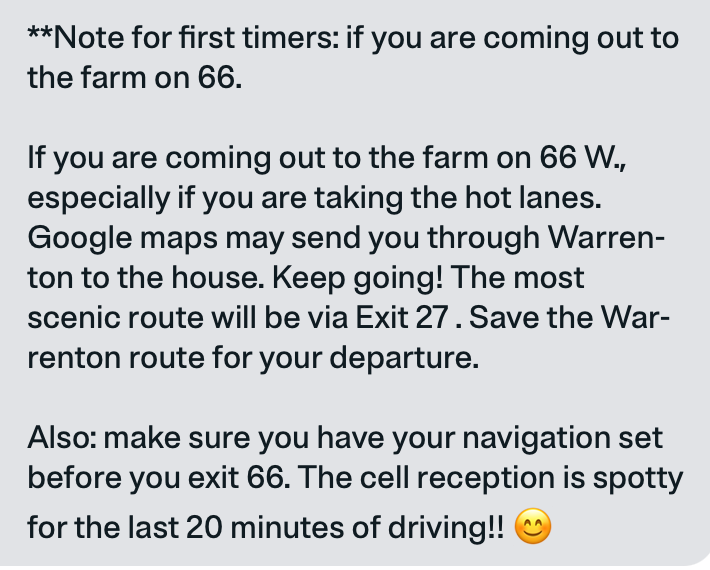
I live in rural Virginia, in the next county over from Paige Flink, and — like many people in rural areas across the country — I’ve often struggled with connectivity and slow internet speeds. On the day I was scheduled to record the first episode of my podcast, I had to race over to friends who have Starlink at the last minute when my connection at home gave out. Last weekend, as I was getting ready to head to a friend’s farm for a party — she lives off backroads far from the main artery of Interstate 66 — I received a reminder to have my navigation set ahead of time, that there’s no cell signal near her. Having moved here a few years ago from New York City, I’ve had to learn these workarounds.
Since 2017, Virginia has committed more than $1.9 billion in combined public and private funds to broadband expansion, with a stated goal of near-universal coverage by 2024. According to the Joint Legislative Audit and Review Commission (JLARC), Virginia’s independent auditing body, fewer than 22 percent of the locations promised under the 2022 funding round had been connected after more than two years. Nine projects had not connected a single location as of November 2024. Twenty-nine of 57 ongoing projects were running behind schedule. JLARC’s conclusion: “inadequate contract provisions and inconsistent state oversight of project performance.” The goal will not be achieved before 2030, at the earliest.
The consequences of that failure are not abstract. In another neighbouring county, a company that received public funding for five years connected only one home out of more than 4,300 promised. Its contract was formally terminated in March 2025, with the county opting to forfeit $13.2 million in state grants rather than extend it further. The chairman of the board of supervisors called it “an abject failure” and the company “an awful non-performing vendor.” Another supervisor said publicly, “we made a mistake when we procured this contract not to put in any timeline penalties.” To date, no one has been held accountable for the lost money. It is simply gone.
Meanwhile, the clock is running. The largest single component of Virginia’s $1.9 billion commitment was a $750 million federal pandemic relief injection, every dollar of which must be spent by the end of this year or returned to Washington. Virginia’s own broadband office has flagged nearly two-thirds of those projects as at some risk of missing that deadline. If they do, the money goes back with nothing built and nothing to show.
According to a recent report in Cardinal News, a separate provider — operating under the same grant programme across twelve counties in another part of Virginia — has connected fewer than a quarter of its contracted locations, with the federal deadline six months away. This company, a regional ISP, ran out of financing when its project expanded. Though the failure looks different from the one in the neighbouring county, the result is the same: public money committed, deadline approaching, residents still waiting.
Which raises the question of how we got here. The Rural Digital Opportunity Fund (RDOF) — a $20.4 billion programme designed during Trump’s first term, at the time described as its “single largest step ever taken to bridge the digital divide” — created the basic architecture: public money flows to private companies to build infrastructure those companies then own outright, with no equity stake for the public and no repayment obligation. The bipartisan Infrastructure Investment and Jobs Act of 2021, which tried to correct for RDOF’s shortcomings with a more rigorous successor — the Broadband Equity, Access and Deployment programme, known as BEAD. It built in a fibre preference for durability, affordability provisions so people could actually pay for the service, digital literacy funding so they could use it, and performance requirements so providers who failed to deliver could be held accountable. It was designed, in other words, with a decade of failures in mind.
One of the firms operating within this architecture is at the centre of a piece I am working on. It manages billions in assets and has ownership with close ties to the current administration — enough to raise questions about whether the accountability mechanisms that exist on paper will ever be applied in practice.
Before you continue, a quick note. For a long time I’ve published everything here for free because I’ve never believed important reporting should sit behind a wall. I still don’t. But reporting takes time, and independent reporting depends on readers willing to support it. Below The Fold is where I publish in-depth reporting, investigations in progress and stories that require more time and resources than a typical essay or column. Paid subscribers receive every edition in full and make the work possible. Thank you for reading.
Keep reading with a 7-day free trial
Subscribe to All That I Have Met to keep reading this post and get 7 days of free access to the full post archives.