
Return Address
Seven decades of US foreign policy and the natural resources that drive it

I know a thing or two about bullies. For more than a decade I had a front row seat to how one of the world’s most powerful industrial empires actually operated. I also spent decades reporting across Africa. The distance between those worlds and this essay is not very great.
And these things don’t happen in a vacuum.
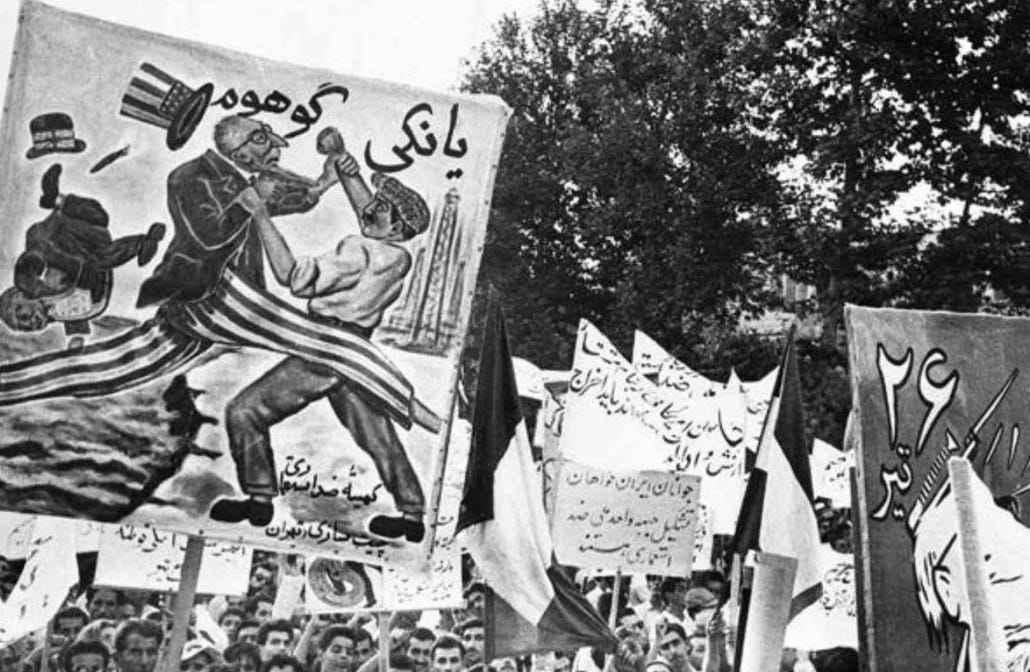
In 1953, Iran's democratically elected prime minister, Mohammad Mossadegh, nationalised his country's oil fields. The Anglo-Iranian Oil Company — which later became BP — held a monopoly on Iran's oil industry under a lopsided agreement that returned as little as 16% of profits to Iran; the company never permitted Iran to see its accounts. Washington initially refused to support British efforts to reverse the nationalisation — President Eisenhower, persuaded that a communist takeover was imminent, ultimately authorised the CIA operation that removed Mossadegh in August 1953. He was tried for treason, sentenced to three years in prison and then kept under house arrest for the rest of his life. The Shah, whose powers had been largely stripped by Mossadegh's government, was restored to full authority. His secret police, SAVAK, operated with American funding and training for the next 26 years. As for the oil: the United States did not restore the British monopoly. Instead, American companies were cut into a new National Iranian Oil Company alongside British and European firms, on a 50/50 profit split. The 1979 revolution and everything since flows directly from that decision.
In 1954, Guatemalan President Jacobo Árbenz introduced land reform that redistributed unused agricultural land, including large holdings owned by the United Fruit Company, an American corporation. Secretary of State John Foster Dulles had worked for United Fruit’s law firm. His brother Allen ran the CIA and sat on its board. A CIA-backed coup removed Árbenz. Two hundred thousand people died in the civil war that followed.
In the Congo in 1960, Patrice Lumumba became the country’s first democratically elected prime minister following independence from Belgium. The Congo held vast mineral wealth — uranium, cobalt, copper — including the ore used in the Manhattan Project. Within weeks of independence, Belgium backed the secession of the mineral-rich Katanga province. CIA director Allen Dulles told Eisenhower that Lumumba “remained a grave danger as long as he was not disposed of.” Eisenhower authorised his assassination. The CIA’s chief scientist arrived in Congo with poison intended for Lumumba’s food or toothpaste. In the event, he was arrested by soldiers loyal to General Mobutu — who had been installed with American and Belgian backing — transferred to Katanga, tortured, and shot by a firing squad under Belgian command on 17 January 1961. He had been prime minister for less than seven months. His body was dissolved in sulphuric acid. A 1975 congressional investigation confirmed the CIA had plotted his assassination.
The United States then backed Mobutu’s dictatorship for over thirty years. The Congo’s mineral wealth — cobalt, coltan, copper, uranium — went largely unextracted by Western interests during the decades of conflict that followed. That changed in 2025. As M23 rebels, widely reported to be backed by Rwanda, seized control of mineral-rich eastern Congo, the Congolese government approached the Trump administration with a proposal: American companies would receive preferential access to the country’s critical mineral reserves in exchange for US military support. Trump sent Massad Boulos — his senior adviser for Africa and the father of Tiffany Trump’s husband — to Kinshasa to negotiate. In June 2025, Washington brokered a peace deal between Congo and Rwanda. In December 2025, Trump hosted both countries at the White House for the signing of the Washington Accords. “We’re getting for the United States a lot of the mineral rights from Congo,” Trump told the room. The Democratic Republic of Congo is the world’s largest producer of cobalt, accounting for roughly 70% of global production — the mineral without which there is no electric vehicle battery, no smartphone, no modern defence technology.
In Chile in 1973, Salvador Allende nationalised the copper industry, which was dominated by three American corporations — Anaconda, Kennecott and Cerro — that together accounted for more than 80% of Chilean copper production. At the time, Chile held roughly 20% of the world’s known copper reserves. Nixon directed the CIA to destabilise Allende’s government as early as 1970; declassified records show he instructed the agency to “make the economy scream.” A memorandum from Kissinger to Nixon that year stated: “I don’t see why we need to stand by and watch a country go communist due to the irresponsibility of its people.” On 11 September 1973, the presidential palace was bombed, killing Allende. General Augusto Pinochet seized power. Under his seventeen-year rule, more than 3,000 people were killed or disappeared, and tens of thousands more were imprisoned and tortured. The United States recognised the junta immediately and sent Chile almost $350 million in economic aid over the following three years. Nixon later remarked of the coup: “Our hand doesn’t show on this one.” In 1998, Pinochet was arrested in London on an international warrant issued by a Spanish magistrate, charged with genocide, torture and crimes against humanity. He was held under house arrest for sixteen months before being released on grounds of ill health. He died in Chile in 2006 without facing trial.
In Indonesia in 1965, President Sukarno was moving to expropriate American oil companies operating in Sumatra — Caltex and Stanvac — and had aligned his government with the Indonesian Communist Party, then the third largest in the world. Richard Nixon had described Indonesia as “by far the greatest prize in the Southeast Asian area.” A CIA-supported coup brought General Suharto to power. What followed was one of the worst mass killings of the twentieth century. Between half a million and one million people were killed over the following months — Communist Party members, ethnic Chinese, and alleged leftists, hunted down across the archipelago. The US Embassy in Jakarta provided the Indonesian military with comprehensive lists of Communist Party officials, from national leadership down to village cadres — as many as five thousand names. Embassy staff then tracked the progress of the killings by checking off names as they were captured or killed. Approval for handing over the lists came from the top of the embassy, including the US Ambassador. The CIA’s own 1968 assessment called the carnage “one of the worst mass murders of the 20th century.” Suharto remained in power for 31 years. The oil companies continued to operate.
In Iraq in 2003, the stated justification for invasion was weapons of mass destruction. On 5 February 2003, Secretary of State Colin Powell appeared before the United Nations Security Council and told the world: “Every statement I make today is backed up by sources, solid sources. These are not assertions. What we’re giving you are facts.” No weapons of mass destruction were found. Powell later called the speech “a blot” on his record. Iraq held the world’s second-largest proven oil reserves. In November 2002 — four months before the invasion — the Army Corps of Engineers tasked Kellogg Brown and Root, a subsidiary of Halliburton, to develop an oil contingency plan for Iraq. On 8 March 2003, eleven days before the first bombs fell, the Army Corps awarded KBR the no-bid Restore Iraqi Oil contract. An internal Pentagon email dated 5 March 2003 recorded that the contract had been “coordinated” with the office of Vice President Dick Cheney. Cheney had served as Halliburton’s chief executive from 1995 to 2000 and continued to receive deferred compensation from the company while in office. By the time the contract was eventually replaced, Halliburton had been paid $1.59 billion. Pentagon auditors found the company had overcharged the government by $61 million on fuel purchases alone. The FBI opened a criminal investigation. By 2008, American oil companies had signed contracts for Iraqi oil fields, ending 36 years of nationalisation. In October 2025, ExxonMobil, Chevron, and KBR — the same KBR — signed new agreements with Baghdad giving them a direct share of profits and access to physical barrels of crude.
In Ukraine in 2025, the Trump administration’s opening position in peace negotiations was a demand for $500 billion worth of profits from Ukraine’s rare earth minerals, oil, gas and natural resources — framed as repayment for American military aid already provided. The initial draft contract, delivered by Treasury Secretary Scott Bessent to President Zelensky in February 2025, covered the entire economic value of Ukraine’s resources, including its ports. Ukraine holds some of the world’s largest deposits of graphite, lithium, titanium and uranium — minerals essential to defence technology, electric vehicles and the entire clean energy supply chain currently dominated by China. Zelensky rejected the initial terms. Trump called him “a dictator.” When Zelensky said Ukraine did not recognise the aid as a debt to be repaid, Trump threatened to withdraw American military support entirely. A joint investment fund was eventually signed on 30 April 2025, under which Ukraine would contribute 50% of future royalties from newly issued licences for critical minerals, oil and gas. Ukraine retained formal ownership of its resources. It did not retain the leverage it had before the negotiation began. No security guarantees were included in the final agreement.
In Iran in 2026, three months into an active war with a ceasefire on life support and the Strait of Hormuz still closed, the outlines of a potential deal have begun to emerge. Among Iran’s pre-war offers to Washington: participation rights for American companies in Iran’s oil and gas industries. Among the conditions now being discussed: Iran’s right to sell oil freely again. Seventy-three years after the CIA removed a prime minister for nationalising his country’s oil fields, the negotiation is still, at its core, about the same thing.
In each case, a sovereign government moved to control, or was asked to share, its natural resources. The Cold War framing — the communist threat, the Soviet alignment — was the blanket justification from an earlier era. What has remained, post-Cold War, is access.
For decades, American foreign policy came with a humanitarian wrapper. USAID delivered food, medicine and infrastructure to more than a hundred countries. PEPFAR prevented an estimated 26 million deaths from HIV/AIDS across sub-Saharan Africa. GAVI vaccinated hundreds of millions of children. The Young African Leaders Initiative brought a generation of Africans to American universities and sent them home connected to Washington. The United States funded almost 25% of the WHO budget and underwrote much of the UN. The generosity was real. So was the calculation behind it. The money was never unconditional, the relationships were never without expectation, and the goodwill it generated made it considerably harder for recipient governments to say out loud what they actually thought of American foreign policy. Soft power is still power.
When Elon Musk called USAID “a criminal organisation” and dismantled it in February 2025 — eliminating 90% of its contracts and most of its 10,000 staff — he was not eliminating waste. He was removing that wrapper.
Exploitation on this scale, across this many countries and this many decades, does not magically disappear. It has a return address.
Brava. The recent chapter I would add is Venezuela: Maduro’s capture in January 2026, followed almost immediately by U.S. claims over oil access in the country with the world’s largest proven reserves.
And then there is the long ledger: Central America, Korea, Vietnam, Iraq, and all the smaller interventions people forget because they never received the full Hollywood-war treatment.
The United States has carried out more than 200 military interventions since 1945, with 114 since 1989 alone. So yes, the language changes from anti-communism to democracy to human rights to security. The pattern stays remarkably steady: trade routes, resource access, strategic control.
Still counting.
It's shifted from gold to tea to rum to opium to oil to rare minerals, but the story remains the same.
Excellent, well-crafted piece!