
The Bitter Pill
How safe are prescription drugs — and are we in danger of slipping into a new 21st-century addiction?
This article was first published in Porter Magazine, Summer 2014 By Meredith Ogilvie-Thompson • Photography by Liz Collins
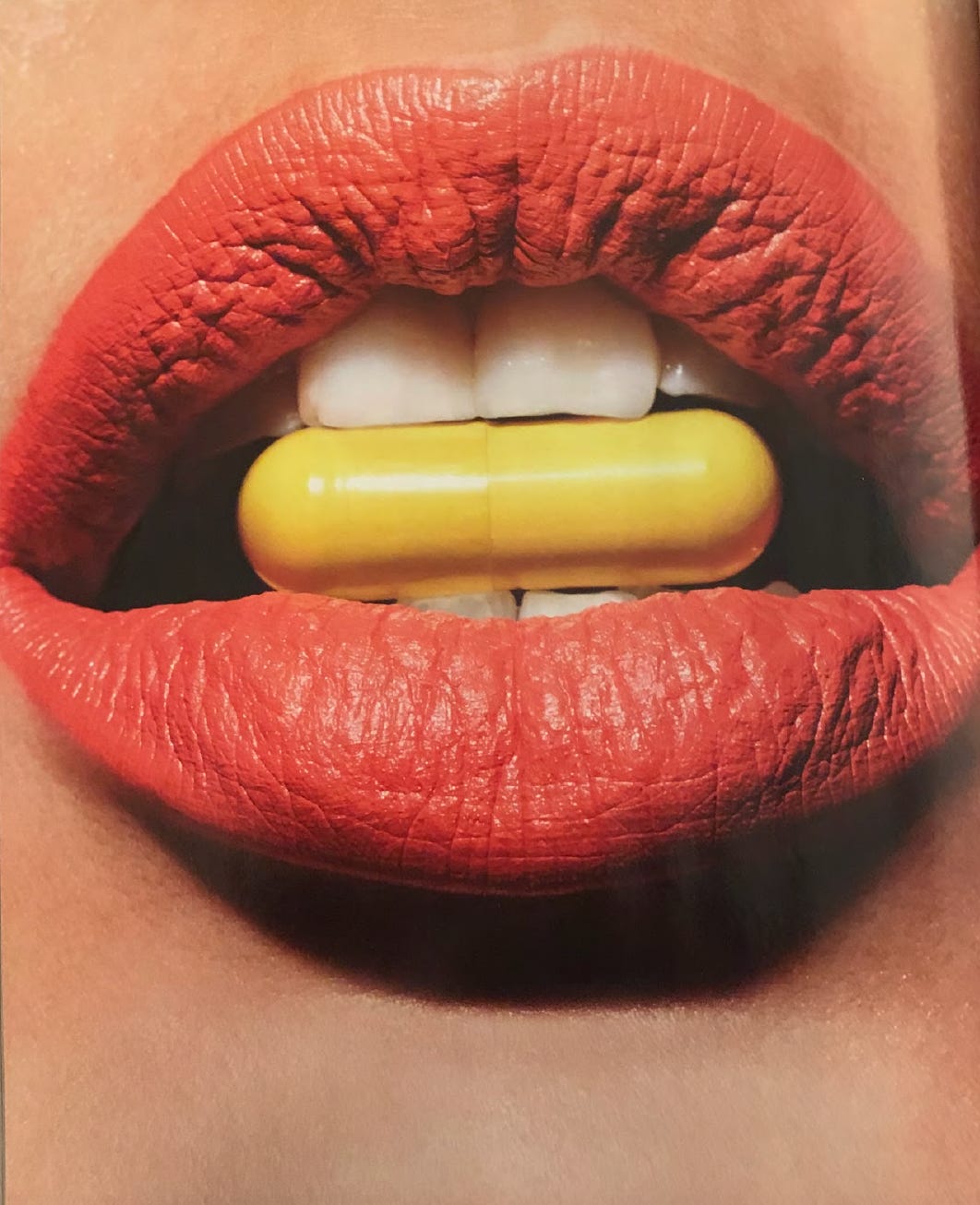
What soporific or nerve-calming drug would a nervous and worried young lady in the smart set be likely to take, and what would be its effects if deliberately taken with the intent to kill herself?
This query was posed not during the 1992 inquest into the death of Viscountess Rothermere, London’s colorful socialite and pioneer doctor-shopper, who accidentally overdosed while on vacation in the south of France, where she was found with over 2,000 pills in 75 different bottles. Rather, it was asked nearly 100 years earlier by the novelist Edith Wharton as she researched the fate of Lily Bart, tragic heroine of The House of Mirth, whose fatal overdose from the sedative chloral hydrate was reported to have shocked readers.
There has been no shortage of untimely deaths attributed to prescribed drugs: Marilyn Monroe, Dorothy Dandridge, Elvis Presley, Margaux Hemingway, Anna Nicole Smith, Heath Ledger, Whitney Houston and Michael Jackson are just a few. Prescription painkillers were even suggested to have triggered the slide back into heroin use that ended the life of Philip Seymour Hoffman. So why is the use — abuse, really — of prescription medication seemingly more pervasive than ever?
“Everyone I know is on [the sedatives] Ambien or Lunesta, and a lot of women I know are on [the anxiety medication] Xanax,” a New York friend told me not long ago. “People tell me stories of taking Ambien and not being able to get up in the morning to take their kids to school. And I have friends who use it as an excuse when they miss a date.”
And the men? Do they pop and tell as well? “My husband never tells me about his friends using like this, but husbands talk about their wives,” she says. “One, in particular, is apparently up all night, sleeps all day and can’t get out to shop for groceries because she takes too many appetite suppressants.”
As an American who spent much of her childhood in London in the ’70s, my friend remembers a guest from the US asking to be taken to a pharmacy to buy a painkiller that didn’t need a prescription in the UK. “Codeine, maybe,” she thinks.
In truth, society’s determination to alleviate pain — from the reputed use of electric catfish in ancient Egyptian medicine, to aspirin’s antecedent willow bark, prescribed by Hippocrates himself, to the laudanum favored by Victorian doctors — dates back thousands of years. The original ‘war on drugs’, the Opium Wars, were fought in the 19th century between a British government keen to maintain its lucrative drug trade and a Chinese court that was equally keen to address the widespread addiction of its subjects. America’s own war on drugs was launched by President Nixon in 1971 and has been something of an embarrassment to every president since, exacerbated beyond all expectation not by the proliferation of international drug cartels, but by America’s own pharmaceutical industry.
According to the Centers for Disease Control and Prevention (CDC), drug-overdose death rates in the US have more than tripled since 1990. A vast majority are caused by prescription painkillers, sales of which have increased by over 300 percent since 1999. According to congressional testimony from the American Society of Interventional Pain Physicians, Americans consume an astonishing 80 percent of the world’s pain pills despite constituting only 4.6 percent of its population.
“No doubt, many [prescriptions] are for perfectly legitimate reasons and are not misused or abused,” says CNN’s chief medical correspondent Dr Sanjay Gupta. “Yet, culturally, we have become increasingly intolerant of even minor amounts of pain and increasingly comfortable with taking heavy-duty medications.”
In the 50 years since the creation of benzodiazepines — the class of drug that includes Valium and Xanax — a host of anxiolytics, stimulants and hypnotics have been developed to relieve our anxiety, help us focus and put us to sleep, from Klonopin and Ativan to Ritalin, Adderall, Vyvanse, Ambien, Lunesta and Imovane. And, like jeans, Big Macs and iPhones, America’s remedies for all manner of physical and emotional discomfort are trending globally.
“I’d like to talk about how many of our friends in Hong Kong, women mainly, are on Xanax and sleeping pills, how crazy it is, but I can’t,” a professional mother of two tells me. “All I can say is it’s a lot, and has definitely got worse.”
In the UK, a 2013 headline in the Daily Mail proclaimed, “A nation of prescription drug addicts: More Britons die from abusing painkillers and tranquilizers than heroin and cocaine”, while an article from 2012 in The Guardian reported that one in 10 Britons regularly takes sleeping pills. According to the UN’s drug-monitoring body, the International Narcotics Control Board (INCB), prescription-drug abuse first started to exceed illegal drug use around the world in 2007.
It’s a trend that has been described as ‘emotional technology’: explaining the growth in the use of synthetic mood-changers as a reaction to the loss of intimacy — actual, one-to-one human contact — that so many of us have experienced thanks to the prevalence of digital communication. It’s not the first time in history that such a trend has been noticed. It was in the post-industrial era, as more and more people migrated to burgeoning cities, leaving family and close friends behind, that the diagnosis of depressive disorders first took hold. Would it not follow, then, that depression and anxiety would be more acute today as our communication defaults to email, texts and social media? We see one another less, rarely pen a handwritten note, hardly even speak on the phone, and have allowed the likes of Facebook and Twitter to somehow quantify our popularity and worth.
Worryingly, no demographic is more rooted in this new technology than our children. The social acceptability of pill-popping appears to be morphing from a suburban-housewife cliché to a teenage epidemic. According to Dr Gregory Smith, assistant clinical professor at UCLA and producer of the documentary American Addict, prescription drug abuse in the US is rife among 12 to 17 year-olds, with one in four (nearly five million) admitting to abusing them, and one in eight misusing stimulants such as Adderall or Ritalin.
These numbers are less surprising, however, when you consider that 15 percent of American teenagers aged 14 to 17 have been diagnosed with Attention Deficit Hyperactivity Disorder (ADHD). The CDC reports that the number of children being prescribed Adderall, Ritalin or other stimulants has exploded from 600,000 in 1990 to a staggering 3.5 million today.
Ann Matthews, a social worker and, for 17 years, the counsellor at an elite New England boarding school, has closely followed the description of ADHD in the Diagnostic and Statistical Manual of Mental Disorders (DSM), the bible of the American Psychiatric Association. “The criteria for diagnosis have become broader and broader over the years,” she says, citing “impulsive, disorganized, distracted, interested in a lot of things, can’t focus on one thing” as just some of the DSM’s indicators, many of which could apply to anyone on any given day.
I tell her the list sounds like an introduction to raising teenagers. “Teenagers have yes wiring,” she agrees. “They’re supposed to have as many experiences as possible.” She steers me to a piece in The New York Times, published in December 2013, entitled “The Selling of Attention Deficit Disorder”. The article minces no words in implicating direct-to-consumer advertising, a uniquely American phenomenon that permits pharmaceutical companies to peddle their wares to the public, entirely bypassing health practitioners.
“When federal guidelines were loosened in the late ’90s to allow the marketing of controlled substances directly to the public, pharmaceutical companies began targeting the most impressionable consumers of all: parents, specifically mothers,” she explains. As the article notes, “The Food and Drug Administration has cited every major ADHD drug — stimulants like Adderall, Concerta, Focalin and Vyvanse, and nonstimulants like Intuniv and Strattera — for false and misleading advertising since 2000, some multiple times.”
I ask a friend and mother about the phenomenon. “With three children aged 11 to 28, I’ve witnessed the enormous acceptance of and interest in medicating children,” she tells me. “What was almost never discussed 20 years ago is now considered a frequent solution in many situations. I’m curious as to why most European countries have significantly lower diagnoses. One would certainly expect the advertising push to be a contributor in this country, where direct-to-consumer advertising is permitted, unlike in most other countries.”
Her statement resonates with my own experience. Having lived in London for much of my adult life — my sons were born and raised in the city — I simply did not experience a culture of medicating children. It was only after I returned to the US that I became personally aware of it, when a child psychologist attempted to pin the ADHD tag — complete with a list of suggested medication — on one of my boys.
While in the UK last Christmas, I found myself chatting about parenting one evening with a group of friends, all well-educated, professional women. I was interested to learn that a few of them met regularly as a small group to discuss parenting issues, with a teacher to guide their conversation. “Meeting as a group allows us to talk about issues that may seem small on the surface, but can become overwhelming at times,” says Allie Esiri, a writer and mother of three. “It’s a lot about listening and communicating and is very constructive.” Does the subject of ADHD and medication ever come up, I ask? “In my wide circle of friends, I haven’t heard of any child being put on drugs,” she replies. “I guess the British aren’t as keen on doctors. I’d say we’re more about trying to work things out.”
The New York-based child psychiatrist Dr William Olcott has a great deal of experience in evaluating and treating ADHD. While he believes that in some cases a correct diagnosis can indicate the need for drug therapy, he advises parents to ask questions, and is encouraging of those who resist medicating their children.
Is there a correlation between parent and child when it comes to prescriptions, I ask? “There can be, if a parent’s only experience of treatment is drugs, not therapy,” says Olcott. “I have psychoanalytic training, so I put a lot of emphasis on psychotherapy that seeks to understand the child, to help them mobilize what they have within them to spur growth and development.”
Coming from a doctor, it is a statement that gives me hope. It also reminds me that progress can be made when it comes to health and safety. After all, it wasn’t long ago that therapy itself was stigmatized, people smoked on airplanes and hardly anyone bothered with seat belts.
The trouble is, it’s not so simple when the pendulum swings the other way, and parents steal their kids’ medication. A Hong Kong-based father of two tells me, “I’ve heard about bankers out here who use Ritalin. They say it gives them a leg up. Pretty much everyone I know who has used it for that sort of fast-paced mathematical work says it’s great.” So what happens when the kids’ supplies run out? “Bangkok. It’s more lax than Hong Kong, with more independent pharmacies,” he says. “As for Ambien, codeine and Endocet, you don’t even need a prescription.”
As I write, recent recommendations by the US government to curb prescription drug use are starting to be implemented, including the formation of a national prescription-drug monitoring program to identify patients at risk of addiction, more education and prevention efforts for doctors and patients, and a move to mandate that all controlled substances be prescribed electronically. The New York Times also reports that the Resource for Advancing Children’s Health (REACH) Institute has begun to hold seminars across the country, to help medical practitioners more accurately diagnose ADHD and assess those who truly need drug therapy.
Hopefully these recommendations will not only prove effective, but, like the trend for Big Macs, iPhones and prescription drug abuse itself, spread globally as well.